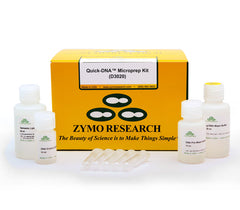
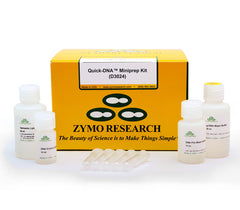
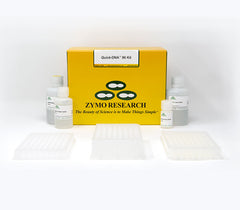
About Quick-gDNA™ MiniPrep
The Quick-gDNA™ MiniPrep is for the convenient, rapid isolation of total DNA (e.g., genomic, mitochondrial, viral) from a variety of biological sample sources. Whole blood (fresh or stored), serum, plasma, buffy coat, solid tissue, bone marrow and buccal cells, cells from culture, and many biological liquid samples can be processed with these kits. The product features Fast-Spin column technology for high-quality DNA purification in minutes. PCR inhibitors are effectively removed, and the eluted DNA is suitable for PCR, nucleotide blotting, DNA sequencing, restriction endonuclease digestion, bisulfite conversion/methylation analysis, and other downstream applications.
| Format | Spin Column |
|---|---|
| DNA Recovery | Typically, up to 25 µg total genomic DNA is eluted into ≥ 50 µl DNA Elution Buffer or water. Human whole blood will yield 33 ng - 66 ng DNA per µl blood sampled. |
| Processing Time | 15 min |
| Equipment | Microcentrifuge, vortex. |
| DNA Size Limits | Capable of recovering genomic DNA >40 kb. In most instances, mitochondrial DNA is also recovered. |
| Sample Sources | Whole blood, plasma, or serum from humans, mice, rats, etc. Also, tissue, cells from culture, buccal cells, as well as a variety of liquid samples are effectively processed using this kit. |
| DNA Purity | High-quality DNA is eluted with DNA Elution Buffer or water that is especially well suited for PCR and other downstream applications. Typical absorption indices are A(260/280nm) >1.8. |
| Product Detergent Tolerance | ≤5% Triton X-100, ≤5% Tween-20, ≤5% Sarkosyl, ≤0.1% SDS |
![]() |
DNA isolated from porcine whole blood using the Quick-gDNA™ MiniPrep. Equivalent amounts (100 µl) of blood were processed without Proteinase K using the Quick-gDNA™ MiniPrep in half the time as compared to the kits from suppliers A and B. Equal volumes of eluted DNA were then analyzed (in duplicate) in a 0.8% (w/v) TAE/agarose/ethidium bromide gel. The size marker "M" is a 1 kb ladder (Zymo Research).
|
| Step 1 | Add 400 µl of Genomic Lysis Buffer to 100 µl of blood, serum, or plasma (4:1). Mix completely by vortexing 4-6 seconds, then let stand 5-10 minutes at room temperature. Note: Add 200 µl Genomic Lysis Buffer to all samples <50 µl. For samples larger than 50 µl, add a proportional amount (4:1) of Genomic Lysis Buffer (e.g., Add 800 µl Genomic Lysis Buffer to 200 µl blood). |
|---|---|
| Step 2 | Transfer the mixture to a Zymo-Spin™ Column in a Collection Tube. Centrifuge at 10,000 x g for one minute. Discard the Collection Tube with the flow through. |
| Step 3 | Transfer the Zymo-Spin™ Column to a new Collection Tube. Add 200 µl of DNA Pre-Wash Buffer to the spin column. Centrifuge at 10,000 x g for one minute. |
| Step 4 | Add 500 µl of g-DNA Wash Buffer to the spin column. Centrifuge at 10,000 x g for one minute. |
| Step 5 | Transfer the spin column to a clean microcentrifuge tube. Add ≥50 µl DNA Elution Buffer or water to the spin column. Incubate 2-5 minutes at room temperature and then centrifuge at top speed for 30 seconds to elute the DNA. The eluted DNA can be used immediately for molecular based applications or stored ≤-20ºC for future use. |
Featured Citations
|
The Quick-gDNA MiniPrep enabled the recovery of high quality DNA from blood pathogens for whole genome analysis of bacterium that cannot be cultured in vitro. The sequenced genome provided clues to the mechanism of pathogenicity.
|
|
The Quick-gDNA MiniPrep kit was used to extract inhibitor-free DNA from the blood of pigs infected with Mycoplasma suis. The purified DNA was used in the development of a qPCR assay that is highly sensitive and specific for M. suis detection and quantification.
|
|
"This product was amazing! I've used the same type of kit (quick DNA extract) from Sigma and this was far more superior. I used the same amount of postnatal tissue as I would have for the Sigma kit, however the yield I obtained from Zymo was quite astounding considering the time of tissue digestion. Secondly, the gDNA was much 'cleaner' upon measurement with our NanoDrop! "
|
|
Stephen C. (Johns Hopkins University School of Medicine)
|
|
“This kit did a good job of prepping clean genomic DNA.”
|
|
Tara N. (United States Agricultural Research Service)
|
|
“It was easy to work with, protocol easy to follow”
|
|
Tinatin T.
|