Activating Library Autopilot to Scale the Scientific Journey
Every scientific journey begins with a question that opens a door to numerous paths of discovery. The journey to discovery used to always be a manual one, requiring countless hours of pipetting by hand to work through mountains of samples. Today, automation can accompany scientists along their journey to simplify the path from workflow to result.
Over the past couple of weeks, researchers learned about how to speed up workflows by taking the Library Fast Lane and how to recover reliable data by conquering the challenging inputs of the Library Labyrinth. This week will incorporate both goals, exploring hands-off, automated techniques for fast, accurate results.
As the capabilities of laboratory technologies continue to improve, an interesting question arises: how much of a researcher’s time should be spent processing samples, and how much should be spent interpreting the biology behind them? The answer is beginning to reshape the way scientists approach library preparation. Workflows once built around repetitive manual processing are evolving into scalable, automation-friendly solutions capable of supporting larger studies and increasingly complex biological questions.
How to Multiply Results
This NGS November, Zymo Research is celebrating the scientists pushing the boundaries of NGS library preparation. Scientists are using cutting-edge technologies to blaze the trail of discovery and pioneer routes to new answers. Empowering researchers as they set out on their scientific journey, Zymo Research is offering a weekly series throughout November to visit several common friction points in library preparation. This week, we’re covering how automation-friendly workflows can help scientists focus less on the library preparation itself and more on the insights uncovered.
Automation for library preparation workflows is expanding, helping researchers move beyond repetitive manual tasks and focus on the bigger scientific questions that first sparked their curiosity. By reducing hands-on processing and improving consistency across samples, automated workflows allow laboratories to scale ambitious projects without proportionally increasing benchwork. Especially for clinical settings and other laboratories that work with biohazardous materials, adoption of automated workflows offers a route to minimize sample handling, reduce labor, and maximize consistency.
As the volume of sequencing data continues to grow, automation is becoming more than a convenience. It’s a powerful traveling companion that helps scientists spend less time managing workflows and more time interpreting discoveries, developing new hypotheses, and charting the next destination on their scientific journey.
By engineering scalable, automation-friendly workflows, Zymo Research is helping scientists reduce repetitive manual processing to save more time in their jam-packed schedules. Explore the products below to see how to quickly and reliably prepare sequencing-ready libraries after activating Library Autopilot.
Cost-Effective DNA Methylation Profiling at Single-Nucleotide Resolution
Methylation is an important epigenetic mechanism that regulates gene expression. By examining methylation patterns across a genome, scientists can gain valuable insights into vast areas of research, including disease progression, developmental processes, and the impact of environmental factors on gene expression. Reduced Representation Bisulfite Sequencing (RRBS) offers a cost-effective, high-throughput alternative for DNA methylation profiling, enabling researchers to screen large numbers of samples across diverse species, from humans to non-model organisms. The drop-in, high-throughput Zymo-Seq RRBS Library Kit requires only 10 ng of genomic DNA to profile methylation at single nucleotide resolution. RRBS combines restriction enzyme digestion with bisulfite sequencing to enrich for CpG-dense fractions of the genome. By sequencing only fragments from CpG-dense regions, RRBS captures a significant percentage (≥ 70% if using human genomic DNA) of methylation data from CpG islands, promoters, and gene bodies while reducing sequencing cost. When every sample requires fewer reads, more samples can be multiplexed during each run, making the automation-friendly RRBS Library Kit ideal for high-throughput screening and pilot studies. For a custom protocol to automate the Zymo-Seq RRBS Library Kit, visit protocols.io.
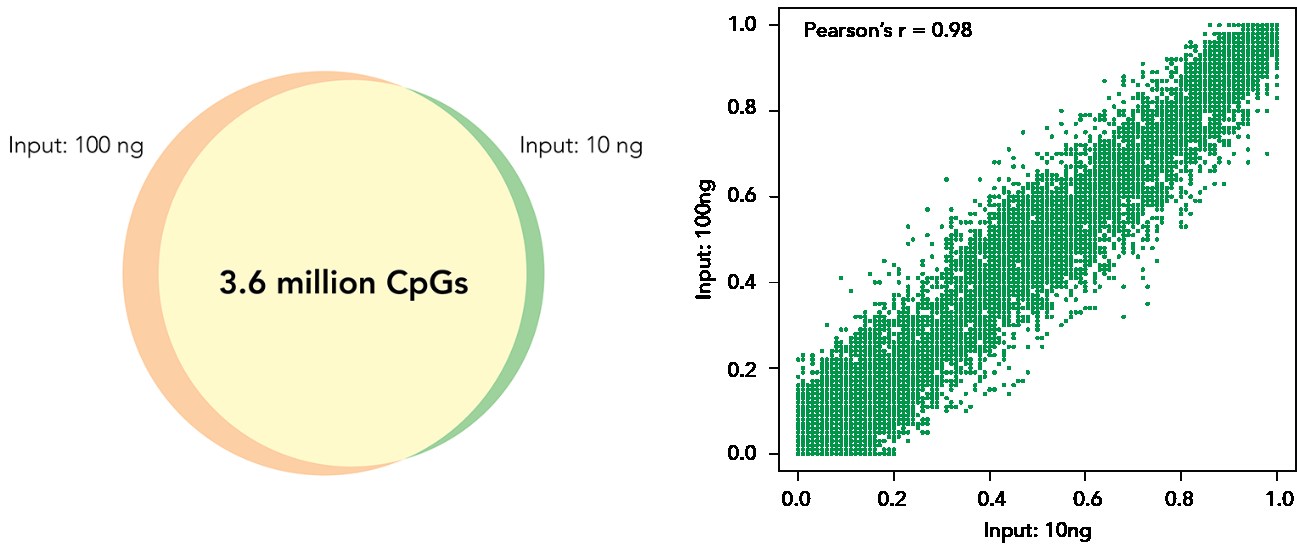
High consistency achieved with different input amounts. Libraries constructed with Zymo-Seq RRBS Library Kit using 10 ng and 100 ng of human liver genomic DNA. Left: Overlap of CpG sites detected (≥5X). Right: Methylation ratio correlation of CpG sites detected (≥50X).
100% Automation Ready 16S rRNA Gene Sequencing
Microbiome profiling can require processing many samples at once, but the time and cost of high throughput shotgun metagenomics sequencing quickly becomes prohibitive. Instead of sequencing the whole genome, 16S sequencing specifically targets microbial 16S rRNA for species identification, providing one avenue to reduce sequencing cost. The ultra-fast, normalization-free Quick-16S™ Plus kits are 100% automation ready and compatible with common automation platforms, such as those provided by Hamilton, Tecan, Beckman Coulter, Opentrons, and Eppendorf. With only a single qPCR/PCR step that combines targeted amplification with barcode addition, Quick-16S Plus kits prepare libraries for immediate pooling in just the first step. Then, libraries can be combined by equal volume and cleaned up in just a single tube. Automation provides further speed and convenience to an already fast workflow, leading to rapid library generation for quick sequencing turnarounds. For scripting assistance with your workflow, contact our automation scientists.
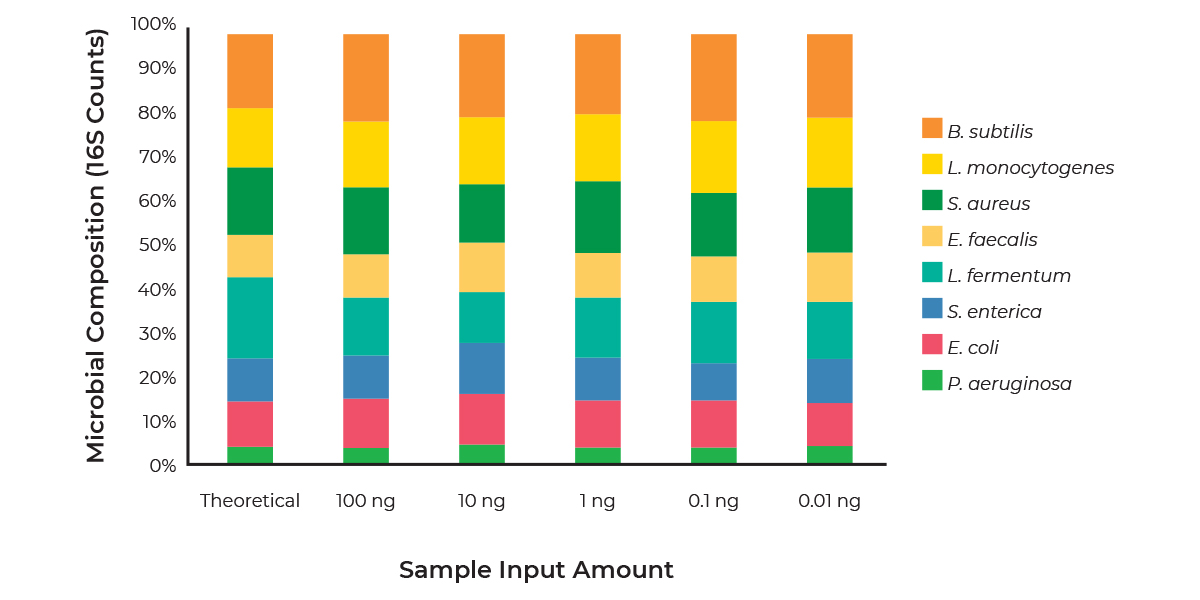
The Quick-16S™ Plus NGS Library Prep Kit (V3-V4) has consistent and accurate measurements across a wide range of input DNA.
More Products to Activate Library Autopilot
Transcriptomics: The probe-free Zymo-Seq RiboFree® Total RNA Library Kit provides automation-friendly total RNA library preparation to scale high-throughput workflows for any species in as little as 4 hours.
Where Will NGS Pioneers Go Next?
After activating Library Autopilot, where will NGS Pioneers go next?
Scientists are familiar with uncertainty. Uncertainty is often found in hypotheses and biological interpretations. It shouldn’t be found in workflows.
Next week, we’ll arrive at the Lasting Library and explore workflows that cut through bias and artifacts so that libraries can be sequenced with confidence.