
Conquering the Library Labyrinth During the Scientific Journey
Every scientific journey begins with a question that opens a door to numerous paths of discovery. However, the trek to find answers is always different. Sometimes, reaching results is like a pleasant hike. In other cases, it can feel like an uphill battle, or even a never-ending maze. No matter how challenging the course is, researchers persevere through innovation and ingenuity, prepared to tackle the surprises found at every turn.
Last week, taking the Library Fast Lane helped researchers choose a path that shortened the time spent at the bench to reach results faster. But, what if an uncooperative sample is blocking entry to the Library Fast Lane, leading scientists further and further into a labyrinth of unsuccessful trials, low yields, and messy data?
On their own, lengthy library preparations can be hard enough. When working with challenging inputs, like rare cell types, library preparation can become a major obstacle to discovery. Navigate past the protocol modifications, optimizations, and repeated sample collections with products designed to help scientists escape the Library Labyrinth.
How to Recover Data Reliably
This NGS November, Zymo Research is celebrating the scientists pushing the boundaries of NGS library preparation. Scientists are using cutting-edge technologies to blaze the trail of discovery and pioneer routes to new answers. Empowering researchers as they set out on their scientific journey, Zymo Research is offering a weekly series throughout November to visit several common friction points in library preparation. This week, we’re exploring products to help scientists reliably recover data when preparing libraries from challenging inputs, like limited starting materials.
Samples, like rare cell types collected through fluorescence-activated cell sorting (FACS), forensic samples and more, frequently rely on low inputs for library preparation. Limited starting material increases the risk of loss throughout long library preparation protocols, where steps like bead-based clean-ups can leave precious molecules behind. But, scientists with challenging input types don’t have to navigate the Library Labyrinth alone. By developing library prep workflows that can handle low inputs, and by providing DNA and RNA extraction kits that effectively remove the inhibitors attributed to library prep failure, Zymo Research is passing researchers a torch so that they can escape the maze of non-optimal protocols and reliably recover the data they need for discovery.
Conquer the Library Labyrinth by exploring products that will remove obstacles in the way of library preparations with challenging starting materials.
mRNA Libraries from as Little as 10 ng Total RNA
Samples can be limited, leading to low yields after RNA purification and sparse starting materials that make long library preparations riskier. Even a small amount of RNA loss during each step of the protocol can affect relatively large portions of low-input libraries, potentially resulting in biased data or even failed experiments. The Zymo-Seq SwitchFree™ 3′ mRNA Library Kit only requires 10 ng of total RNA to prepare mRNA libraries. During cDNA synthesis, oligo(dT)-based primers simultaneously incorporate the P5 adapter sequence and a Unique Molecular Identifier (UMI), which allows for accurate evaluation of duplication rates. The SwitchFree™ technology then ligates the P7 adapter directly to the first strand of the cDNA before library amplification. Don’t watch pieces disappear before the puzzle is put together; SwitchFree™ opens the door to recover reliable data for protein-coding gene expression analysis, even with low inputs.
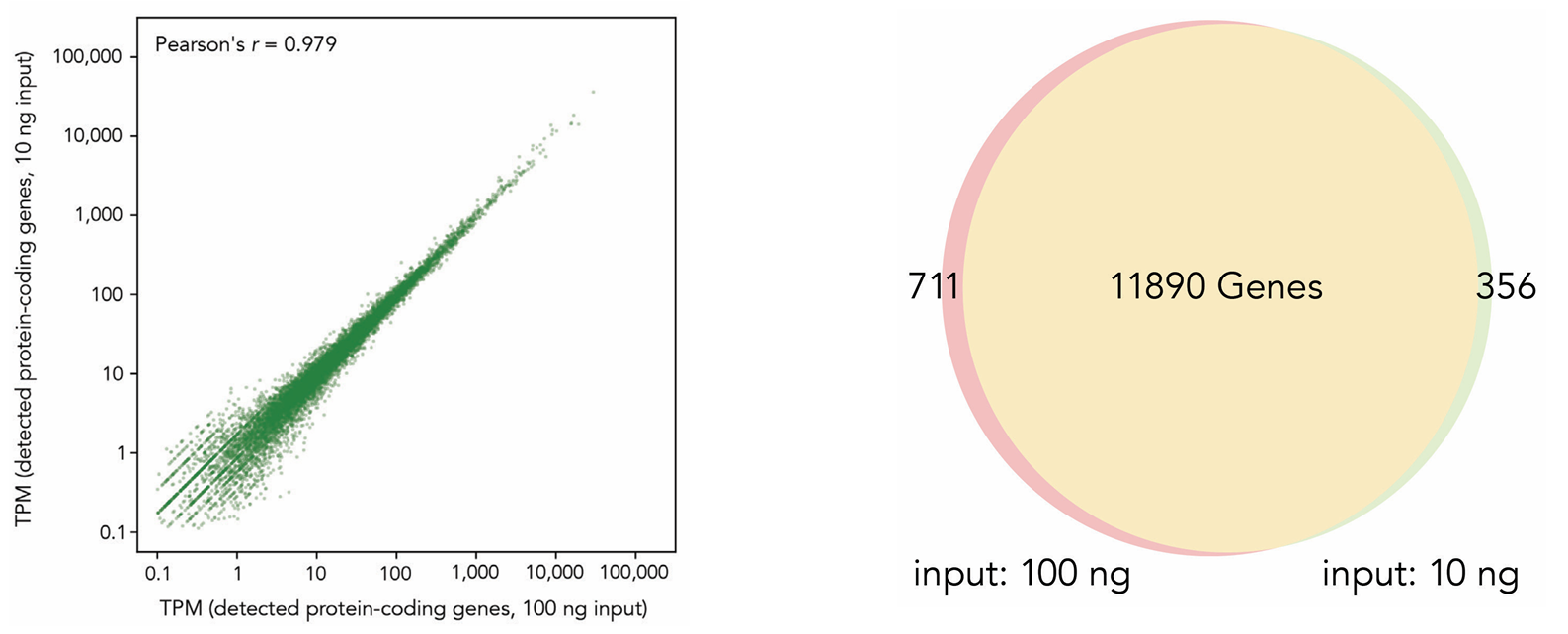
High consistency achieved in protein-coding gene detection with different input amounts (unique Ensembl GRCh38 gene IDs, TPM > 0.1). Zymo-Seq SwitchFree™ 3′ mRNA libraries were prepared with 100 ng and 10 ng of input HeLa RNA (RIN > 8), respectively. Left: TPM correlation between libraries. Pearson’s r calculated on log-transformed TPM values. Right: Overlap of detected protein-coding genes between libraries. 5 million reads per library (read length of 150 bp) were used for the shown analysis. TPM: Transcripts Per Million.
More Products to Conquer the Library Labyrinth
Epigenomics: The Pico Methyl-Seq Library Prep Kit Plus requires as little as 50 pg of input DNA to prepare whole-genome bisulfite sequencing (WGBS) libraries and is now open for beta testing (contact us if interested). The kit delivers outstanding sequencing performance and methylation-calling accuracy, surpassing other commercially available DNA methylation profiling technologies.
Microbiomics: The Quick-16S™ Plus kits provide fast, accurate profiling of microbial samples. By using a single simultaneous amplification and barcoding step, complex microbial communities can be untangled with reliable species-level resolution.
Where Will NGS Pioneers Go Next?
After conquering the Library Labyrinth, where will NGS Pioneers go next?
The pursuit of answers only leads to more questions – and more samples.
Fortunately, improvements in technology allow scientists to process more samples than ever before. Next week, we’ll explore how activating Library Autopilot can multiply your results.
References:
- Raine, et al. Nucleic Acids Research. 2017; 45 (6): e26